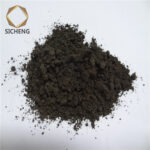
What Amorphous Boron Powder Is Used For
Amorphous (non-crystalline) boron powder differs from the crystalline grade in one key way: it is highly reactive, has a large specific surface area, and disperses easily. It is specified wherever boron has to actually react, dissolve or burn — not just sit in the mix.
1. Energetic materials — the largest application group
- Ignition and priming compositions — high heat of combustion and a low ignition threshold make it a standard component of boron-based igniters.
- Solid rocket propellants / boron-based fuels — a high-energy fuel additive; gravimetric heat value far above hydrocarbon fuels.
- Fireworks, signal and tracer compositions — green flame colour with easy ignition.
- Pyrotechnic delays and detonator timing elements.
This group is the most sensitive to particle size (D50 commonly 1–5 µm, sub-micron for some grades) and boron content, and it attracts the most export-control scrutiny.
2. Metallurgy and alloys
- Boriding (boronizing) of steel — forms a FeB / Fe₂B hardened surface layer for significantly improved wear resistance.
- Boron steels and alloy additions — trace boron markedly improves hardenability.
- Copper, magnesium and aluminium-based composites — property improvement, grain refinement or strengthening phase.
- Sintering additives and deoxidizers for metal powders.
3. Ceramics and refractories
- Sintering aid for B₄C, TiB₂, BN and SiC ceramics — promotes densification and lowers sintering temperature.
- Precursor for boride ceramics — B₄C, TiB₂, ZrB₂ and other ultra-high-temperature ceramics.
- Boron source in specialty glass, glazes, enamels and glass fibre.
- Bonding / oxidation-resistant component in refractory formulations.
4. Vacuum and atmosphere engineering
- Oxygen getter under vacuum or protective atmosphere — removes residual oxygen and protects sintered parts and electronic components.
- Deoxidation and atmosphere conditioning in powder metallurgy.
5. Nuclear industry
- Neutron-absorbing material — boron has a large neutron-capture cross-section; used for shielding and control materials and as a B₄C precursor. (Note: compliance requirements for this use are stringent.)
6. Other applications
- Catalysts and catalyst-support modification
- Semiconductor doping source / specialty coatings
- Abrasive and grinding-media additive
- Precursor for boron fibres and boride whiskers
- Flame-retardant / high-temperature composite filler